 AOD 9604 (5mg)
  KLOW - GHK-Cu (50mg) / KPV (10mg) / BPC-157 (10mg) / TB500 (10mg)
GLP-1 R
Price range: $125.00 through $400.00
Description
A single-component research material supplied for controlled research environments. Suitable for studies involving GLP-1 receptor–related pathway characterization and method development in model systems.
Composition
• GLP-3 RT
• Appearance: Lyophilized powder in a sealed research vial
Research Focus (non-clinical)
• Peptide identity and purity assessment via HPLC/LC-MS
• Assay development and calibration for quantitative analysis of GLP-1 receptor–related models
• Chromatographic method optimization for impurity profiling and peak resolution
• Stability characterization of a lyophilized peptide under laboratory storage conditions
For qualified research professionals and institutional laboratories. Not for human use.
Documentation & Quality Assurance
Each lot is sourced through our verified global supply chain with emphasis on traceability and quality control. We work diligently to obtain and maintain third-party analytical reports (HPLC/LC-MS) and Certificates of Analysis for each batch, as part of our ongoing quality process. These documents are reviewed internally and displayed as they become available. Independent third-party testing is also performed on select lots to confirm identity, purity, and alignment with our internal specifications.
Important Notice
This product is intended for laboratory research use only. It is not intended for human or veterinary use, and must not be used for diagnostic, therapeutic, or clinical purposes.
This material is not a drug, medical device, or dietary supplement, and has not been evaluated by the U.S. Food and Drug Administration.
Quality & Manufacturing
All materials are sourced from carefully vetted domestic and international manufacturing partners who follow quality systems consistent with ISO and cGMP principles. Each supplier is reviewed for reliability, documentation integrity, and transparency in testing.
We require a verified purity of 99% or higher and perform independent third-party spot testing to confirm that select lots meet our internal standards for identity, purity, and composition. Where available, endotoxin testing results are included on Certificates of Analysis to verify laboratory purity; their inclusion is for research quality assessment only and does not imply suitability for human or veterinary use.
All research materials are sealed for integrity and packaged for stability during storage and transport from manufacturing through final delivery.
Additional information
| Weight | 0.2 lbs |
|---|---|
| Dosage | 10mg, 20mg, 30mg, 40mg, 50mg |
Storage Instructions
All our research peptides are manufactured using a lyophilization (freeze-drying) process. This method is designed to maintain product integrity and allows vials to remain stable during shipping for approximately 3–4 months.
Once a vial is reconstituted with bacteriostatic water, it should be stored in the refrigerator to help maintain stability. Under these conditions, reconstituted material is generally considered stable for up to 30 days.
Lyophilization is a dehydration technique in which compounds are frozen and then exposed to low pressure. This causes the water in the vial to sublimate directly from solid to gas, leaving behind a stable, crystalline white structure. This powder can be kept at room temperature until reconstitution.
Upon receipt, products should be stored away from heat and light. For short-term use, refrigeration at approximately 4°C (39°F) is suitable. For long-term storage (several months to years), vials may be placed in a freezer at approximately -80°C (-112°F). Freezing is the preferred method for preserving product stability over extended periods.
⚠️ Important Notice: These products are intended for research use only. Not for human consumption.
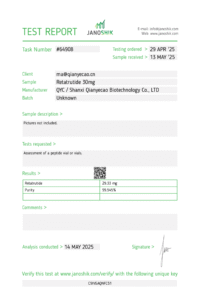
Certificate of Analysis
Research Use Only
These studies reference research-grade peptides for laboratory and scientific investigation only. Not for human consumption. Not intended to diagnose, treat, cure, or prevent any disease.
Published Scientific Research
Peer-reviewed laboratory research investigating glp-1 receptor agonists from leading scientific databases
GLP-1, GIP/GLP-1, and GCGR/GLP-1 receptor agonists: Novel therapeutic agents for metabolic dysfunction-associated steatohepatitis.
Progression into fibrotic stages of MASLD is also strongly associated with liver-related mortality. Studies on GLP-1 agonists, such as liraglutide and semaglutide, have demonstrated efficacy in MASH management, albeit with limited histological improvement of fibrosis.
View Full StudyA systematic review of GLP-1 on anthropometrics, metabolic and endocrine parameters in patients with PCOS.
However, achieving and maintaining weight loss can be challenging, and pharmacological agents could be essential to achieve optimal glycemic control and improve the endocrine disturbance associated with polycystic ovary syndrome. In conclusion, glucagon-like peptide-1 receptor agonists effectively reduce body weight and improve some of the endocrine and metabolic parameters of polycystic ovary syndrome.
View Full StudyMolecular Imaging in neuroendocrine neoplasias.
Molecular imaging, which uses molecular targets due to the overexpression of specific peptide hormone receptors on the tumour surface, has become an indispensable diagnostic technique. Neuroendocrine neoplasms (NENs) especially differentiated NENs or neuroendocrine tumours (NETs) are a rare group of heterogeneous tumours, characterized by the expression of hormone receptors on the tumour cell surface.
View Full StudyCardiovascular Safety and Benefits of Semaglutide in Patients With Type 2 Diabetes: Findings From SUSTAIN 6 and PIONEER 6.
placebo for major CV events was seen with lixisenatide and exenatide extended-release, while superiority was demonstrated with liraglutide, albiglutide, and dulaglutide. Both indirect mechanisms risk factor modification and direct effects GLP-1 receptors in the CV system have been proposed to be responsible for CV event reductions.
View Full StudyStructural basis for GLP-1 receptor activation by LY3502970, an orally active nonpeptide agonist.
Glucagon-like peptide-1 receptor (GLP-1R) agonists are efficacious antidiabetic medications that work by enhancing glucose-dependent insulin secretion and improving energy balance. We report the discovery and mechanism of action of LY3502970 (OWL833), a nonpeptide GLP-1R agonist.
View Full StudyRecent Insights Into Mechanisms of β-Cell Lipo- and Glucolipotoxicity in Type 2 Diabetes.
The molecular mechanisms underpinning lipo- and glucolipotoxic β-cell dysfunction and death comprise endoplasmic reticulum stress, oxidative stress and mitochondrial dysfunction, impaired autophagy, and inflammation. Crosstalk between these stress pathways exists at multiple levels and may aggravate β-cell lipo- and glucolipotoxicity.
View Full Study